Scottish chapbook literature by William Harvey
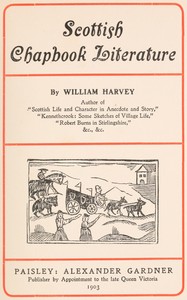
Scottish chapbook literature by William Harvey is a literary history written in the early 20th century. It surveys the rise, character, and influence of Scotland’s cheap popular print—broadsides and chapbooks—and the chapmen who sold them, tracing their growth, peak, and decline. The study highlights major types (humorous, instructive, romantic, superstitious, and songs/ballads), key authors and printers, and includes illustrations, notes, a glossary, and indexes to guide readers. The opening of the book
states its aim to give a concise account of the chapman and his wares across roughly three centuries, with plentiful extracts, biographical and bibliographical notes, a list of titles, and reproductions of crude but revealing woodcuts. It defines “chapbook” by distribution rather than size, sketches the pedlar’s hard, news-bearing life, and outlines early Scottish printing (Chepman and Myllar), Reformation broadsides, censorship, and the rise from single sheets to song-sheets and small booklets, through Allan Ramsay, into the main chapbook era, which the author places from the late 17th to early 19th century. It marks Dougal Graham as the pivotal figure and explains the later decline as new cheap series displaced the old, noting poor paper, short type supplies, piracy, and comically misused woodcuts, as well as a few short-lived serials; English imports are acknowledged but set aside. The first main section, “Humorous,” centers on Graham—his Jacobite camp-following, and lively pieces like Jockey and Maggy’s Courtship, The Coalman’s Courtship, and The Haverel Wives—which vividly portray rustic wooing, riotous weddings, kirk discipline, and anti-Popish satire; it also touches his more anecdotal collections, the semi-autobiographical John Cheap the Chapman, Leper the Taylor, later figures such as William “Hawkie” Cameron, the respectable Mansie Wauch, and popular verse and jest-books. The text then turns to “Instructive” chapbooks—first, historical narratives (Bothwell Bridge and Drumclog by an eyewitness, and Graham’s metrical history of the ’45), and topical broadsides and “last speeches” sold at executions, illustrated with a peddler’s sharp-eyed account of hawking a bogus reprieve. (This is an automatically generated summary.)
Read or download for free
For an overview of the different reading options, see our Reading Guide
| Reading Options | Url | Size | |||
|---|---|---|---|---|---|
| Read now! | https://www.gutenberg.org/ebooks/77447.html.images | 310 kB | |||
| EPUB3 (E-readers incl. Send-to-Kindle) | https://www.gutenberg.org/ebooks/77447.epub3.images | 1.3 MB | |||
| EPUB (older E-readers) | https://www.gutenberg.org/ebooks/77447.epub.images | 1.3 MB | |||
| EPUB (no images, older E-readers) | https://www.gutenberg.org/ebooks/77447.epub.noimages | 247 kB | |||
| Kindle | https://www.gutenberg.org/ebooks/77447.kf8.images | 1.6 MB | |||
| older Kindles | https://www.gutenberg.org/ebooks/77447.kindle.images | 1.5 MB | |||
| Plain Text UTF-8 | https://www.gutenberg.org/ebooks/77447.txt.utf-8 | 227 kB | |||
| Download HTML (zip) | https://www.gutenberg.org/cache/epub/77447/pg77447-h.zip | 1.4 MB | |||
| There may be more files related to this item. | |||||
Similar Books
About this eBook
| Author | Harvey, William, 1874-1936 |
|---|---|
| LoC No. | 04000735 |
| Title | Scottish chapbook literature |
| Original Publication | Paisley: Alexander Gardner, 1903. |
| Credits | Mairi and the Online Distributed Proofreading Team at www.pgdp.net (This file was produced from images generously made available by The Internet Archive) |
| Language | English |
| LoC Class | PR: Language and Literatures: English literature |
| Subject | Scottish literature -- History and criticism |
| Subject | Chapbooks, Scottish -- History |
| Subject | English literature -- Scottish authors -- History and criticism |
| Subject | Popular literature -- Scotland -- History and criticism |
| Category | Text |
| EBook-No. | 77447 |
| Release Date | Dec 12, 2025 |
| Copyright Status | Public domain in the USA. |
| Downloads | 673 downloads in the last 30 days. |
| Project Gutenberg eBooks are always free! | |