Haut-Sénégal-Niger (Soudan français), Tome 3 (de 3): les civilisations by Delafosse
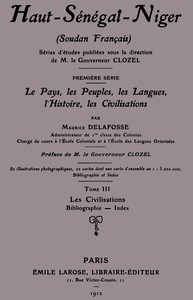
"Haut-Sénégal-Niger (Soudan français), Tome 3 (de 3): les civilisations" by Delafosse is a historical-ethnographic study written in the early 20th century. It examines the societies of the French Sudan (Upper Senegal–Niger), focusing on customary law, social and political organization, religion, and material culture across multiple peoples. The volume’s aim is to describe indigenous civilizations on their own terms and to distinguish them from Islamic jurisprudence and French colonial regulations. The opening of
the work reframes “civilization” in the plural and sets out to study local customs—civil, social, political, and religious—rather than Islamic law or French administrative rules, noting that Muslim codes are only partially and unevenly adopted. It cautions against forcing French legal categories or codifying fluid customs, and proposes instead to extract core principles and explain indigenous legal mentality. Beginning with “Les biens,” it details land tenure: collective ownership of soil by the polity or its chief as administrator; families hold usufruct and own only the products of their labor; public domains (waters, paths, markets) carry shared rights; hunting and fishing are regulated by locale and season. Nomads follow analogous rules for fields and pastures, while Maliki law, where invoked, allows private ownership through first cultivation and defines strict limits to usufruct (habous). It then treats movable property broadly (crops, houses, tools, herds), showing how labor creates full private or collective ownership, with the family estate managed by a head, women’s equal rights to own and dispose, limited rights of serfs, property marks, and practices for lost goods and stray animals. Finally, it outlines successions: separating private goods from the inalienable family estate; procedures for heirs, incapacity, repudiation, wills and donations, the status of widows and minors, and Islamic adjustments; and three inheritance systems—uterine, consanguine, and patriarchal—whose common aim is to keep property within the lineage, closing with rules for children born out of wedlock. (This is an automatically generated summary.)
Read or download for free
For an overview of the different reading options, see our Reading Guide
| Reading Options | Url | Size | |||
|---|---|---|---|---|---|
| Read now! | https://www.gutenberg.org/ebooks/77846.html.images | 3.2 MB | |||
| EPUB3 (E-readers incl. Send-to-Kindle) | https://www.gutenberg.org/ebooks/77846.epub3.images | 5.8 MB | |||
| EPUB (older E-readers) | https://www.gutenberg.org/ebooks/77846.epub.images | 5.8 MB | |||
| EPUB (no images, older E-readers) | https://www.gutenberg.org/ebooks/77846.epub.noimages | 756 kB | |||
| Kindle | https://www.gutenberg.org/ebooks/77846.kf8.images | 6.3 MB | |||
| older Kindles | https://www.gutenberg.org/ebooks/77846.kindle.images | 6.0 MB | |||
| Plain Text UTF-8 | https://www.gutenberg.org/ebooks/77846.txt.utf-8 | 794 kB | |||
| Download HTML (zip) | https://www.gutenberg.org/cache/epub/77846/pg77846-h.zip | 5.7 MB | |||
| There may be more files related to this item. | |||||
Similar Books
About this eBook
| Author | Delafosse, Maurice, 1870-1926 |
|---|---|
| Contributor | Clozel, F.-J. (François-Joseph), 1860-1918 |
| Title | Haut-Sénégal-Niger (Soudan français), Tome 3 (de 3): les civilisations |
| Original Publication | Paris :Émile Larose, 1912. |
| Credits | Galo Flordelis (This file was produced from images generously made available by the HathiTrust Digital Library) |
| Language | French |
| LoC Class | DT: History: General and Eastern Hemisphere: Africa |
| Subject | Mali |
| Category | Text |
| EBook-No. | 77846 |
| Release Date | Feb 3, 2026 |
| Copyright Status | Public domain in the USA. |
| Downloads | 425 downloads in the last 30 days. |
| Project Gutenberg eBooks are always free! | |