
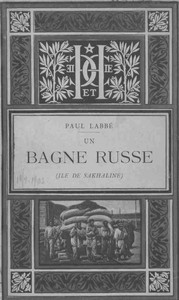
Un bagne russe: l'île de Sakhaline by Paul Labbé
QR code
"Un bagne russe: l'île de Sakhaline" by Paul Labbé is a historical travel account written in the early 20th century. It investigates Russia’s Sakhalin penal colony through on-the-ground observation, blending geography, administration, and ethnography with a close look at prisons, punishments, colonization efforts, and everyday life. The narrator’s journey highlights systemic cruelty, corruption, and failure alongside a few humane officials and the notable contributions of political exiles. The opening of the work
sketches Sakhalin’s harsh setting—rugged coasts, brutal climate, dangerous waters—and its shift into a Russian penal colony, then outlines the island’s administration. Three guiding themes emerge: the land’s physical and economic realities, the penal system, and indigenous peoples; the author quickly argues the penal-colonization scheme is misguided—prisons act like squalid inns, “freedom” brings worse hardship, agriculture falters, while fisheries and mines might succeed. He arrives at Alexandrovsk, observes convicts at work under guard, meets the governor and staff, gains broad but curated access, and confirms reports of cruelty, graft, drinking, and gambling, even as some doctors prove humane and political exiles teach, research, and serve. Living among prisoners, he records the story of Vassily Tcherkachine and the brutal Odessa–Sakhalin transport on the Yaroslav—cages, suffocating heat, rough discipline, quarantine—and notes his own thefts as typical of daily insecurity. Hospitals are overcrowded; a small asylum holds many alcohol-damaged minds, with striking cases and even feigned madness for better food. The prison regime is detailed: time split between “correction” and “improvement,” chain-gang labor, thin rations (including brick tea), frequent escapes, and punishments from irons and dark cells to the knout and, rarely, hangings. He exposes routine malversation by prison heads and guards and the uneven leniency granted to the well connected. Finally, he sketches the villages built by convicts (posselentsy)—their layout, meager tools and livestock on credit, the crushing work of clearing land, social stratification, crime and illicit alcohol, the staroste’s local power—and begins contrasting deported women with voluntary wives under a controlled concubinage system. (This is an automatically generated summary.)
Download for free
For your e-reader or reading app — Kindle, Kobo, Apple Books, Calibre etc.
Kindle → Use Send-to-Kindle
Kobo, Nook etc. → Transfer via USB
Phone, tablet or computer → Open in a reading app
Other formats & older devices
There may be more files related to this item.
About this eBook
| Author | Labbé, Paul, 1867-1943 |
|---|---|
| LoC No. | 05001453 |
| Title | Un bagne russe: l'île de Sakhaline |
| Original Publication | Paris: Hachette, 1903. |
| Credits | Laurent Vogel, Pierre Lacaze and the Online Distributed Proofreading Team at www.pgdp.net (This file was produced from images generously made available by the Polona digital library) |
| Language | French |
| LoC Class | DK: History: General and Eastern Hemisphere: Russia, Former Soviet Republics, Poland |
| Subject | Sakhalin (Sakhalinskaia oblastʹ, Russia) |
| Category | Text |
| eBook-No. | 78671 |
| Release Date | May 12, 2026 |
| Copyright | Public domain in the USA. |
| Downloads | 1168 downloads in the last 30 days. |
Project Gutenberg eBooks are always free!