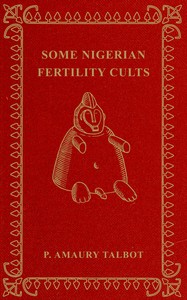
Some Nigerian fertility cults by Percy Amaury Talbot
QR code
"Some Nigerian fertility cults" by Percy Amaury Talbot is an ethnographic monograph written in the early 20th century. It examines fertility-focused beliefs, symbols, shrines, and ceremonies among the Ibo, Ijaw, and neighboring peoples of Southern Nigeria, especially the Earth Goddess Ale (Ala) and the Thunder God Amade Onhia, Mbari/’Mgbe temples, and great drums such as the Ikoro. Based on field observations made during colonial administrative work, it links sexuality, agricultural plenty, ancestor
veneration, and social control through detailed ritual and iconography. The opening of this study sets its scope and sources in Degama Division, then moves to vivid case studies: a rebel episode around a blood-smeared “great drum,” the Ikoro war drum with headhunting rites, and its carvings (serpent as phallic emblem, tortoise as feminine symbol, crescent moon of growth, crocodile, horn, dog, and a lingering double‑axe motif). It introduces Mbari houses at Omo Dim and elsewhere—complex, frescoed temples explained locally as ancestral but read by the author as shrines to Ale and Amade Onhia—detailing their secret construction by selected men and women under priestly command, nocturnal clay-gathering from termite mounds, strict taboos, and public rites to “release” the workers, all credited with boosting crops and human fertility. The narrative records explicit fertility tableaux, the ape Ogbango as the form of wicked souls and a sexual aggressor in lore, an Otaminni river-spirit Mbari, and widespread moon and rainbow symbols, including a Mbolli yam shrine with blood running over moon-shaped hollows. It describes twin houses for Thunderer and Earth Mother at Obogwe, the “big woman who cooks” nurturing moon-faced boys and star-marked girls, and juxtaposes sexual license in ritual with everyday prohibitions (no intercourse on earth or in daylight, modesty rules, and severe taboos). Notes on neighboring practices—bestiality tests, homoerotic clubs like Obukere tied to magical increase, camwood-smeared sacred groves, and clustered phallic shrines—broaden the fertility theme. Further vignettes show Thunder God iconography (white figure with rattles, rainbow, storm-time trumpets), guardian figures, ordeal customs, “palms of the Thunderer,” and a priest dining amid seed-yams and a king-yam emblem to charge fertility. The section on Sky and Earth unpacks the blending of Igwe and Amade Onhia, a pilgrimage to Ozozo with “thunderstones” and rainbow signs, sacred-grove taboos, Ale’s grisly Ewawfe shrine with bronze manillas, and burial prohibitions during Ale’s holy times (and related Okrika/Ibibio rules). It then opens a chapter on Ibudu, the male and female genital shrines central to granting children, with examples ranging from peg-marked pillars for marriages to a bell-shaped feminine form with tortoise symbol, before breaking off mid-description. (This is an automatically generated summary.)
Download for free
For your e-reader or reading app — Kindle, Kobo, Apple Books, Calibre etc.
Kindle → Use Send-to-Kindle
Kobo, Nook etc. → Transfer via USB
Phone, tablet or computer → Open in a reading app
Other formats & older devices
There may be more files related to this item.
About this eBook
| Author | Talbot, Percy Amaury, 1877-1945 |
|---|---|
| LoC No. | 28010547 |
| Title | Some Nigerian fertility cults |
| Original Publication | Oxford: Oxford University Press, 1927. |
| Credits | deaurider and the Online Distributed Proofreading Team at www.pgdp.net (This file was produced from images generously made available by The Internet Archive) |
| Language | English |
| LoC Class | BL: Philosophy, Psychology, Religion: Religion: General, Miscellaneous and Atheism |
| Subject | Phallicism |
| Subject | Cults -- Nigeria |
| Subject | Nigeria -- Religion |
| Category | Text |
| eBook-No. | 78684 |
| Release Date | May 14, 2026 |
| Copyright | Public domain in the USA. |
| Downloads | 2288 downloads in the last 30 days. |
Project Gutenberg eBooks are always free!